THE LINUX FOUNDATION PROJECTS
Tag

SDCore

Quantum-Secure Aether SD-Core: Implementing Post-Quantum Cryptography in Open 5G Core Networks

By Blog

Contributed by coRAN Labs (CRL)

The 5G evolution is accelerating, unlocking new capabilities across every sector of the global economy. But this progress comes with an equally rapid expansion of the threat landscape. Among the most disruptive risks on the horizon is the rise of quantum computing, which directly threatens today’s cryptographic foundations and, by extension, the security of 5G networks.

At coRAN Labs, we are addressing this challenge head-on by integrating Post-Quantum Cryptography (PQC) into open, cloud-native 5G cores starting with Aether SD-Core. In this blog, we introduce QORE, our Quantum-Secure Aether SD-Core architecture, and show how open ecosystems like Aether can lead the way toward quantum-resilient telecom infrastructure.

The Quantum Threat to Today’s Cryptography

Quantum computing poses an imminent threat to classical security mechanisms, especially asymmetric cryptographic primitives based on the Elliptic Curve Discrete Logarithm Problem (ECDLP) and RSA. Asymmetric cryptography underpins modern network security: it enables secure key exchange for symmetric algorithms such as AES and ChaCha, and is deeply embedded in protocols like TLS/DTLS, IPsec, and more.

A Cryptographically Relevant Quantum Computer (CRQC) capable of executing Shor’s algorithm would efficiently solve the underlying hard problems of these schemes, rendering them insecure.

Two attack models are particularly concerning:

  • Harvest Now, Decrypt Later (HNDL) – Adversaries record encrypted traffic today with the intention of decrypting it once CRQCs become available. Even passive adversaries can eventually break the confidentiality of sensitive traffic, including critical infrastructure data that must remain secret for years or decades.
  • Trust Now, Forge Later – Adversaries can later forge digital signatures, undermining PKI and breaking the trust model for everything from software updates to banking operations.

Active adversaries with access to a CRQC (in the future) would be able to decrypt and forge ongoing communications secured by classical cryptography, leading to man-in-the-middle attacks, impersonation, large-scale data breaches, loss of integrity, and denial-of-service at a systemic level.

Securing 5G Against Quantum Threats with Post-Quantum Cryptography

Given the inevitability of quantum-enabled attacks on conventional cryptography, migrating to Post-Quantum (PQ) methods is no longer optional it is urgent. 5G is a particularly critical target: it carries highly sensitive subscriber data, control-plane signaling, and network configuration. Security failures in 5G can have severe consequences, including:

  • Certificate forgery – Malicious entities can insert themselves into trust chains, disrupt services, and undermine network trust.
  • Key leakage – Exposure of long-term or session keys allows attackers to intercept, manipulate, or block traffic.
  • Authorization failures – In 5G Core Service-Based Architecture (SBA), a broken OAuth flow could let an attacker:
    • Access UE data
    • Manipulate QoS parameters
    • Disrupt control plane signaling
    • Compromise 5G-AKA and SEAF keys
    • Alter network slice profiles, policies, and rules

The risks posed by quantum computers are too broad and long-lived to ignore. 5G security must evolve toward quantum-safety. In this blog, we describe how we integrate NIST-standardized PQ primitives ML-KEM and ML-DSA into open 5G cores, and how we upgrade:

  • TLS & OAuth 2.0 on Service-Based Interfaces (SBI) to PQ-TLS 1.3 and PQ-O Auth 2.0
  • gNB-Core interfaces (NGAP & N3) using PQ-IKEv2 for future-proof tunnel protection  

    Our solution is implemented in open source 5G cores such as Aether SD-Core and free5GC. QORE has been validated with our Q-RAN enhancements, demonstrating robust quantum-safe integration and future-ready interoperability between next-generation 5G Core and RAN components under advanced PQ security standards.

    QORE as a Bridge Between Standards and Quantum-Safe 5G Deployment

    Telecommunication networks especially 5G Core and RAN have long lifecycles and handle mission-critical, privacy-sensitive data. This makes them prime targets for harvest-now-decrypt-later attacks, where adversaries store encrypted traffic today with the aim of decrypting it in the post-quantum era.
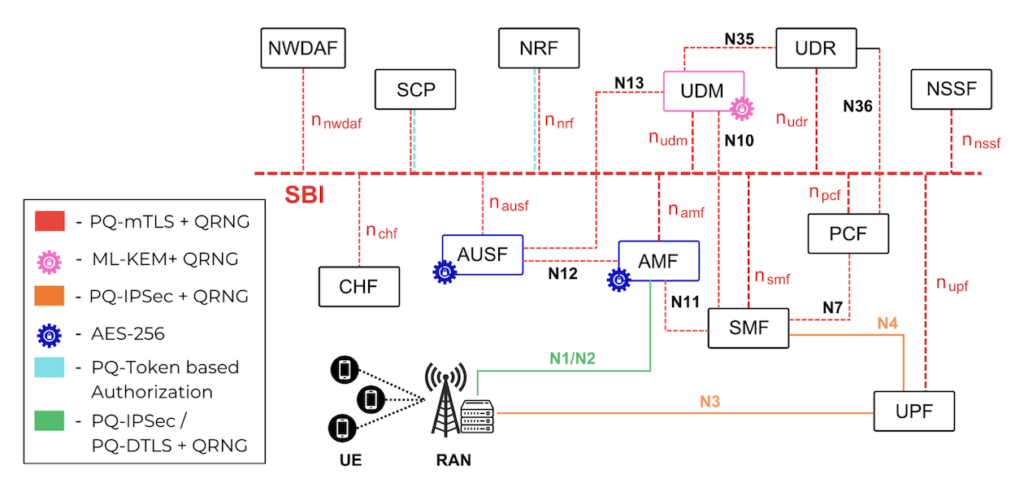
    Figure: QORE – Post-Quantum Secure 5G Core Architecture

    To ensure long-term confidentiality and trust, operators must start phased PQ migration now, guided by open standards and interoperable reference implementations. At coRAN Labs, our Post Quantum upgrade strategy for Aether SD-Core aligns with key international standards under active development:

    At coRAN Labs, our Post Quantum upgrade strategy for Aether SD-Core aligns with key international standards under active development:

    • NIST FIPS 203, 204, 205
      Standardization of ML-KEM, ML-DSA, and SLH-DSA as the foundational PQ primitives for encryption/key encapsulation and digital signatures.
    • IETF drafts for migrating security protocols
      • PQ-TLS 1.3 – Internet-Draft efforts extend traditional protocols (TLS, IPsec, PKIX, etc.) with PQ-KEM and PQ signature schemes. These drafts define identifiers, implementation guidance, and interoperability considerations.
      • X-Wing KEM (draft-connolly-cfrg-xwing-kem-09) – Introduces hybrid KEMs such as X25519MLKEM768, providing stronger protection against binding attacks and improved performance over naive combinations.
      • PQ-X.509 Certificates (draft-ietf-lamps-pq-composite-sigs-13) – Defines composite signature mechanisms that combine a post-quantum signature algorithm with a classical algorithm (e.g., RSASSA-PSS, ECDSA, Ed448, EdDSA), enabling a gradual transition to PQC while preserving confidence in well-understood classical schemes.
    • GSMA PQTN, 3GPP SA3
      • GSMA PQ.03, PQ.05 and related whitepapers provide a roadmap for PQ migration in telecom, covering risks, upgrade paths, challenges, and use cases across 5GC and roaming interfaces.
      • 3GPP SA3 is actively evaluating PQC integration into the 5G Security Framework, focusing on access and core interfaces, authentication, and key management ensuring that PQ adoption does not disrupt service continuity.

    By aligning QORE’s PQ-Aether SD-Core implementation with these standards, we ensure:

    • Interoperability
    • Forward compatibility
    • Crytographic agility

    enabling operators to transiion gradually without disrupting existing deployments.

    Why Aether SD-Core is the Right Platform for QORE

    In a landscape dominated by closed ecosystems, open platforms are essential for transparent innovation, security research, and rapid standard adoption. Aether, as an open source 5G platform under the Linux Foundation, embodies this philosophy.

    Our decision at coRAN Labs to build QORE on Aether SD-Core is driven by several strengths:

    • 3GPP Compliance
      Aether’s adherence to 3GPP specifications ensures interoperability and a standards-aligned foundation for future-proof deployments.
    • Modular Design
      Componentized network functions make it straightforward to integrate custom implementtions such as PQ-capable O Auth server and PQ-aware SBI endpoints.
    • Cloud-Native Architecture
      Aether’s cloud-native design enables highly scalable, observable, and automatable deployments critical for modern DevSecOps workflows and PQ rollouts at scale.
    • End-to-End 5G Core
      Aether SD-Core offers a comprehensive 5G core solution that can be readily deployed in private and enterprise 5G use cases, making it an ideal testbed for PQ upgrades.
    • Community-Driven Development
      Aether is backed by an active community that prioritizes technical excellence, transparency, and shared learning making it a perfect ecosystem for pioneering quantum-safe enhancements.

    Post-Quantum Migration of Aether SD-Core

    Building on Aether’s cloud-native platform, we performed a full Post-Quantum migration of the Service-Based Interfaces (SBI) of SD-Core. Our objective was to keep the same application behavior and performance characteristics while augmenting the security posture with quantum resilience.

    Key aspects of the migration include:

    • Upgrades applied at individual Network Functions (NFs), focusing on SBI server endpoints and their HTTP APIs.
    • For OAuth 2.0, we target the JWT and OpenAPI libraries with necessary modifications in NF components.
    • The Golang toolchain was rebased and patched to natively support PQ primitives:
      • PQ signature schemes (ML-DSA and hybrids)
      • PQ KEMs (ML-KEM and hybrids)
      • PQ-aware X.509 certificate parsing and validation

    We used cryptographic libraries such as Cloudflare’s CIRCL to obtain robust, standards-aligned implementations of PQ primitives.

    Within SD-Core, we focused on three main migration tracks:

    1. TLS 1.3 to PQ-TLS 1.3
    2. X.509 to PQ X.509
    3. OAuth 2.0 to PQ-OAuth 2.0

    About coRAN Labs

    coRAN Labs (CRL) is focused on building secure, open, and interoperable RAN and Core solutions for next-generation telecom networks. Through projects like QORE (Quantum-Secure 5G Core) and Q-RAN, we collaborate with open-source communities such as Aether to provide practical reference architectures and implementations for quantum-safe telecom migration.

    If you are an operator, integrator, or researcher interested in trialing or contributing to QORE on Aether SD-Core or anyCORE, we’d be delighted to collaborate.

    Community Member Profile – Gabriel Arrobo

    By Blog

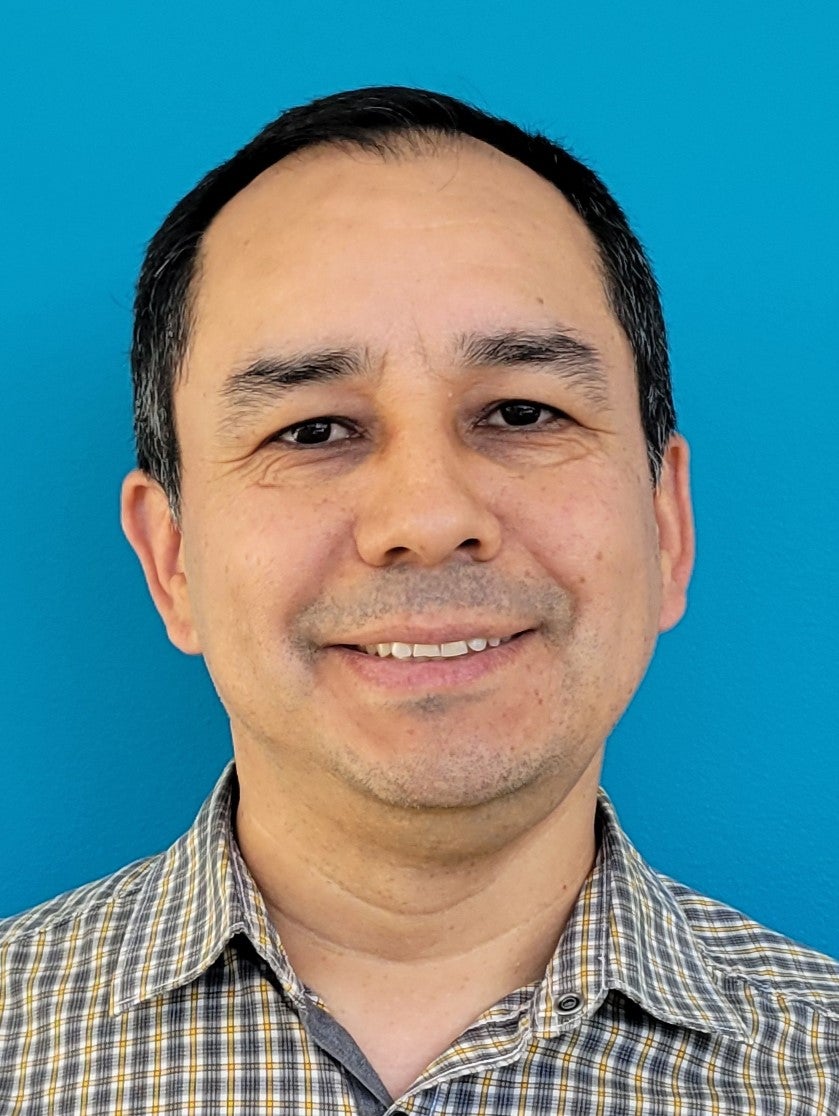
    This Aether community member profile features Gabriel Arrobo. Gabriel is a Senior Cloud Software Architect at Intel and is based in Hillsboro, Oregon.

    Gabriel has been an active contributor to the Aether community since 2022, and he is a member of the Aether Technical Steering Team (TST). Most recently, he led the development of Aether SD-Core over the past few years. Some of his key contributions include implementation of GTPu path monitoring; implementation of the CI/CD pipeline using GitHub Actions; managing the GitHub repositories and container registries for Aether SD-Core and replacing outdated dependencies.

    Gabriel began his telecom education as an undergrad student at Escuela Politécnica Nacional in Ecuador where he studied Electronics and Telecommunications and earned his Engineering degree (5-year degree) in Electronics and Telecommunications, graduating Cum Laude. Following college, Gabriel joined the “Corporacion Nacional de Telecomunicaciones” (formerly ANDINATEL), a telecommunications service provider, where he held various positions ranging from staff engineer to manager, and had the opportunity to work on optical and transport backbone networks, wireless multi-access networks, telephone switching, and network routing. He desired to continue his formal education and moved to the U.S. and earned his M.Sc. in Electrical Engineering from the University of South Florida. During his studies, he pursued an opportunity to work on his doctoral degree and conduct research techniques to improve the reliability of wireless networks, completing his Ph.D. in Electrical Engineering at the University of South Florida. He remained at the University of South Florida as a Postdoctoral Scholar and worked on development of a WiFi-based wireless video camera system for minimally invasive surgeries. 

    Gabriel continued his career at Newfield Wireless (Tektronix/NetScout) with work focused on calibrating RF propagation models for LTE macro and small cells using the company’s proprietary and off-the-shelf software tools, including Newfield’s TruePath, Atoll, GeoPlan and PlanetEV. He also did research on LTE scanner data (RSRP, RSRQ, RS-CINR) to calibrate high quality path loss models and perform statistical analysis of the field measurement data. In 2016, Gabriel joined Intel to work on Wi-Fi differentiations by creating value above the Wi-Fi (MAC/PHY) layer(s) with the goal of improving end users’ quality of experience (QoE). Following Intel, he joined a cellular network standardization team to work on innovations for B5G/6G. Currently, Gabriel is part of the Intel Advanced Technology Group (formerly Intel Labs), and is researching 5G/B5G/6G networks and demonstrating benefits through PoCs using the Aether platform. Gabriel has filed 80+ patent applications (37 patents granted), published 20+ technical papers, and received multiple Intel Labs Division Awards.

    Gabriel was born in Loja, Ecuador. In his free time he values spending quality time with his kids, often driving around the Portland area to attend their games, meets, practices, and recitals. Weekends tend to be full and lively. When the weather cooperates, he enjoys grilling a good piece of picanha and relaxing with family and close friends.

    A special retreat for Gabriel is to enjoy the quiet of the night, especially during a new moon. Whenever he has the chance to get out of town, he escapes to Eastern Oregon or the coast where the skies are clear and dark. There’s nothing more special to him than spending the night under the stars, watching the constellations and the Milky Way in peaceful silence.

    Community Member Profile – Andy Bavier

    By Blog

    This Aether community member profile features Andy Bavier who is based in Tucson, Arizona. 

    Andy has been involved with Aether since its inception in 2020 and served for several years on the Aether Technical Steering Committee as a member of the Open Networking Foundation (ONF) technical team. He contributed to the Monitoring and Alert infrastructure that is an integral part of the Aether Management Plane (AMP). He created multiple dashboards to simplify monitoring of various attributes of Aether, including resource health and subscriber activity.

    Andy created “Aether-in-a-Box” (AiaB), a software tool that enabled developers and researchers to easily setup and deploy Aether’s SD-Core and Runtime Operational Components (ROC) for testing, validation and experimentation on a local machine. It offered a self-contained, simplified way to set up a private 4G/5G network with tools to manage and validate the network, enabling users to test network slices, application integration, and other core Aether features without requiring large-scale infrastructure. AiaB was also leveraged to build the Aether CI pipeline to run E2E integration tests and ensure the quality of Aether releases. AiaB inspired Aether OnRamp, which is the currently recommended method for deploying Aether.

    Andy collaborated on the Pronto Project, a DARPA-funded project focused on building and testing new types of programmable and flexible 4G/5G networks to improve security and performance. The project was led by the ONF and included researchers at Stanford, Cornell, and Princeton universities. As part of this effort, he maintained a centrally-managed Aether at several of the universities for use in project research. He also supported researchers’ experiments to demonstrate and evaluate novel applications using Aether.

    With other members of the Aether community (Larry Peterson, Scott Baker, Zack Williams), he co-authored a book based on hands-on experiences operating Aether and Pronto networks: Edge Cloud Operations: A Systems Approach. Andy was a key contributor to Intel’s open-source Edge Manageability Framework, a secure platform for delivering scalable edge solutions that aligns with the principles described in the Edge Cloud Operations book.

    Andy received a B.A. in Philosophy from the College of William and Mary in 1990, a M.S. in Computer Science from the University of Arizona in 1995, and a Ph.D. in Computer Science from Princeton University in 2004.

    He worked as a Research Scientist at the University of Arizona from 1996 – 1998, contributing to the Scout OS, a research OS for network appliances.  From 2004 – 2017, he was a Research Scholar at Princeton University, where he built and operated distributed testbeds (PlanetLab, VINI, VICCI, GENI) supporting research in distributed systems and networking. From 2015 – 2022 Andy served as a member of the technical staff at ON.Lab / ONF, where he worked on integrating edge clouds with telecommunication technologies in the CORD, SEBA, VOLTHA, and Aether projects.  He joined the Ananki ONF spin out that was formed to commercialize Aether.  After Intel acquired Ananki in 2022, he worked as a Cloud Software Development Engineer at Intel on the Edge Management Framework project.  Andy left Intel earlier this year and is taking time off to plan his next chapter.

    Some of the publications to which Andy has contributed include:

    Andy was born in Providence, Rhode Island. In his free time he enjoys hikes in the Arizona desert, playing guitar with friends, cooking, reading, and drinking good quality coffee and craft beer.

    Community Member Profile – Ajay Lotan Thakur

    By Blog

    This Aether community member profile features Ajay Lotan Thakur. Ajay is a Cloud Software Architect at Intel Corporation and is based in Toronto, Ontario, Canada.

    Ajay has been an active contributing member of the Aether community since its beginning in 2020. From its inception he has been deeply involved in shaping the technical direction and architecture of the Aether platform, with a focus on the advancement of Aether’s 5G SD-Core.

    One of his most significant contributions was in delivery of a robust, scalable, and API-driven open-source 5G SD-Core project. This core is a foundational component of Aether, enabling reliable deployments and serving as a reference implementation for many in the broader open source and telecom communities. He also led the architecture and development of gNBSim, a unique and powerful gNodeB simulator. This tool fills a critical gap in the open source ecosystem by allowing users to simulate RAN behavior without requiring physical hardware. It has proven invaluable not only for Aether users but also for researchers, developers, and operators working on 5G networks globally.

    Ajay also architected and implemented several major features, including the metrics architecture, which provides deep observability into the system’s performance and health. These architectural designs have been widely adopted as reference models by newcomers and other contributors in the community. 

    Within Intel, Aether has been a key component in several strategic initiatives. Most notably, successful demonstration of Aether on Intel’s edge platform as part of the conclusion of the DARPA-funded Project Pronto. This demonstration showcased Aether’s capabilities in delivering programmable, cloud-native 5G infrastructure at the edge. Following the initial success, Intel Labs has continued to work on multiple phases and extensions of Project Pronto which I have provided technical consultation. to the Intel Labs team—particularly to Gabriel and Christian, with Gabriel also serving as a member of the Aether Technical Steering Team (TST). My involvement has helped ensure that Aether’s integration into these research efforts remains aligned with its architectural principles and performance goals.

    In parallel, Ajay has been collaborating with Purdue University on research initiatives conducted in partnership with Intel Labs. This collaboration offered him the opportunity to mentor PhD students working on Aether-related projects. Together, they explored ways to enhance Aether’s scalability and gain deeper insights into its performance characteristics under various deployment scenarios. These efforts led to feeding back improvements to Aether as well as contributions to advance the broader research community’s understanding of open source 5G systems.

    Ajay began his academic journey with a Bachelor’s degree in Electronics and Telecommunication Engineering from SVPM’s Engineering College, Malegaon (BK), affiliated with Pune University. From his early college days, he was deeply curious about computers and programming, and was fortunate to have access to an excellent infrastructure that allowed him to explore and nurture this interest. He later pursued a Master’s degree in Telecommunication Engineering from the Indian Institute of Science (IISc), Bangalore.

    Professionally, Ajay has spent most of his career in the datacom and telecom industries, in architect and technical leadership roles. His work has focused on open source technologies, distributed systems, and cloud-native platforms, including next-generation mobile networks such as 5G.

    Ajay is a Senior Member of IEEE and a Fellow of the British Computer Society (BCS), where he actively mentors new members and contributes to professional development. As part of his IEEE contributions he serves as a Technical Program Committee (TPC) member and program committee member for multiple research conferences where he reviews papers in the areas of distributed systems, networking, and AI/ML, helping to shape the direction of emerging research in these fields.

    Beyond his industry and academic contributions, Ajay has authored multiple technical articles for online platforms and serves as an editorial team member for the IEEE ComSoc TechBlog. His research includes papers on User Plane design using P4 and the architecture of Aether/SD-Core, focusing on performance, scalability, and programmability in modern mobile networks. These contributions have helped advance the understanding and adoption of open-source 5G core technologies. 

    Ajay was born in a village called Dondaicha, located in the Dhule district in the northern part of Maharashtra, India and spent most of his childhood in Pune, a city renowned for its rich educational heritage and vibrant academic environment. Growing up in Pune provided access to excellent learning opportunities that helped shape his early interest in technology and engineering.

    In his free time, Ajay enjoys spending quality time with his daughter and wife. They often explore hidden trails across the Greater Toronto Area, discovering new paths and experiencing nature together. During the winter months, he takes his daughter out for snow activities and ice skating. He and his family enjoy visiting local libraries, where they spend time reading, checking out new topics, and encouraging curiosity and learning as a family. These visits offer them a way to unwind, discover new ideas, and stay connected with the community. Whether it’s hiking, skating, or browsing bookshelves, Ajay values these family experiences and the balance they bring.

    Journey of NgKore and Aether SD-Core

    By Blog

    Contributed by NgKore.

    NgKore is an open-source community led by a group of passionate researchers, engineers, and professionals working to advance the future of 5G Advanced and 6G technologies. Our work spans a wide range of focus areas, including O-RAN, Non-Terrestrial Networks (NTN), AI/ML integration, Post-Quantum Cryptography adoption, blockchain integration, and cloud-native telecom infrastructure.

    At the heart of NgKore is a commitment to openness and interoperability. We actively contribute to replacing proprietary hardware and closed systems with open-source software, enabling vendors, operators, and developers to innovate without being locked into specific solutions. Our team shares complete end-to-end deployment guides, technical insights, and demonstration videos to help others build and scale open telecom systems. 

    Our Journey with the Aether/SD-Core Community

    NgKore’s engagement with open-source 5G began through practical experimentation with platforms such as Magma, Open5GS, Free5GC, and OpenAirInterface (OAI). As our research progressed, we evaluated a range of 5G core implementations for their real-world applicability, scalability, and cloud-native design. Among them, Aether/SD-Core emerged as the most production-ready platform—offering advanced features like Network Slicing, DPDK-SR-IOV and CNDP integration, and Dynamic Scaling capabilities.

    Following extensive lab testing, we adopted Aether SD-Core as the foundation for several of our advanced R&D workflows. We integrated it with real radios, COTS UEs, and O-RAN components, validating its robustness in complex, large-scale deployment scenarios. These efforts were documented and shared through a series of technical demonstrations and walkthroughs, including:

    We successfully integrated Aether SD-Core with open-source RAN solutions such as OAI and SRSRAN, and tested it with commercial O-RUs from LiteON, Benetel, and Accton, alongside various COTS UEs. Additionally, we performed extensive testing with simulators like UERANSIM and gNBsim, and used PacketRusher to simulate thousands of UEs – benchmarking system performance under high-load and failure conditions.

    Leveraging Charmed SD-Core, we achieved user plane scaling through Canonical’s Juju charms. Our team is now actively working on control plane scaling, aiming to build a fully elastic and cloud-native 5G core. We have also validated UPF operation in both AF_PACKET and DPDK with SR-IOV modes.

    As part of our continued contribution, we proposed our open-source project HEXAeBPF to the LFN 5G Super Blueprint. HEXAeBPF is an interoperable eBPF-defined 5G Core (eDC) Kubernetes operator that enables seamless integration between multiple eBPF-based UPFs (such as eUPF, OAI-UPF-eBPF, BPF-UPF) and open-source 5G core solutions including Aether SD-Core.

    Future Work

    Looking ahead, we are expanding our focus on cryptographic resilience in telecom systems. We have implemented Post-Quantum Cryptography (PQC) over Aether/SD-Core—specifically on the SBI and other 3GPP-defined interfaces—and proposed this work under our open-source project QORE to the LF Post-Quantum Cryptography Alliance (PQCA). This effort supports the growing need for quantum-safe, future-ready telecom infrastructure.

    About NgKore

    NgKore Infrastructure and Funding

    NgKore is a non-profit research community founded by university researchers and engineers, sustained entirely through self-funded, bootstrapped efforts. Our progress is made possible through strong collaborations with academic institutions and industry partners, who support us with access to advanced testing infrastructure and resources.

    Collaboration and Community Engagement

    At NgKore, we believe that open innovation thrives through collaboration. Our community actively engages with global open-source foundations and research alliances to co-develop the future of telecom and network infrastructure. As members or associate members of leading open-source and standards organizations—including the Magma Foundation, OpenAirInterface (OAI), LF Connectivity, Open Infrastructure Foundation (OIF), TARS Foundation, NextArch Foundation, and the PKI Consortium—we maintain strong ties with the global open networking community. In addition, we are actively associated with initiatives such as the LFN Super Blueprint (SBP), Hyperledger, LF Decentralized Trust (LFDT), Post-Quantum Cryptography Alliance (PQCA), O-RAN Software Community (OSC), Nephio, L3AF, OpenSSL Foundation and OpenSSL Corporation. We also collaborate closely with industry partners to ensure our work remains grounded in real-world challenges and opportunities.

    Through these collaborations, we share technical knowledge, contribute code, participate in working groups, and support broader efforts to create secure, scalable, and future-ready network solutions. Our involvement extends beyond code—we advocate for openness, diversity, and community-driven progress across the open-source ecosystem.

    Over the years, NgKore has hosted and participated in numerous technical events, talks, and meetups to support open-source education and collaboration. Notable engagements include:

    NgKore 6G Research Lab

    Our primary research facility, the 6G Research Lab, is based at the University of Delhi and serves as a hub for experimentation in 5G Advanced, 6G, and edge technologies. The lab houses a mix of COTS and high-performance servers, more than 14 radios (including SDRs and commercial O-RUs), multiple COTS UEs, PTP switches, GNSS receivers, high-speed NICs, and hardware accelerators.

    In addition to core telecom infrastructure, the lab supports experimentation across emerging verticals with AR/VR/XR headsets, drones, HoloLens, robotics, and IoT devices. This enables us to validate open-source solutions in realistic, high-impact scenarios—from immersive communication and industrial automation to autonomous systems and intelligent networking.